Small Sustainable Changes We Are Making
Wildflower Meadows and Grass Management
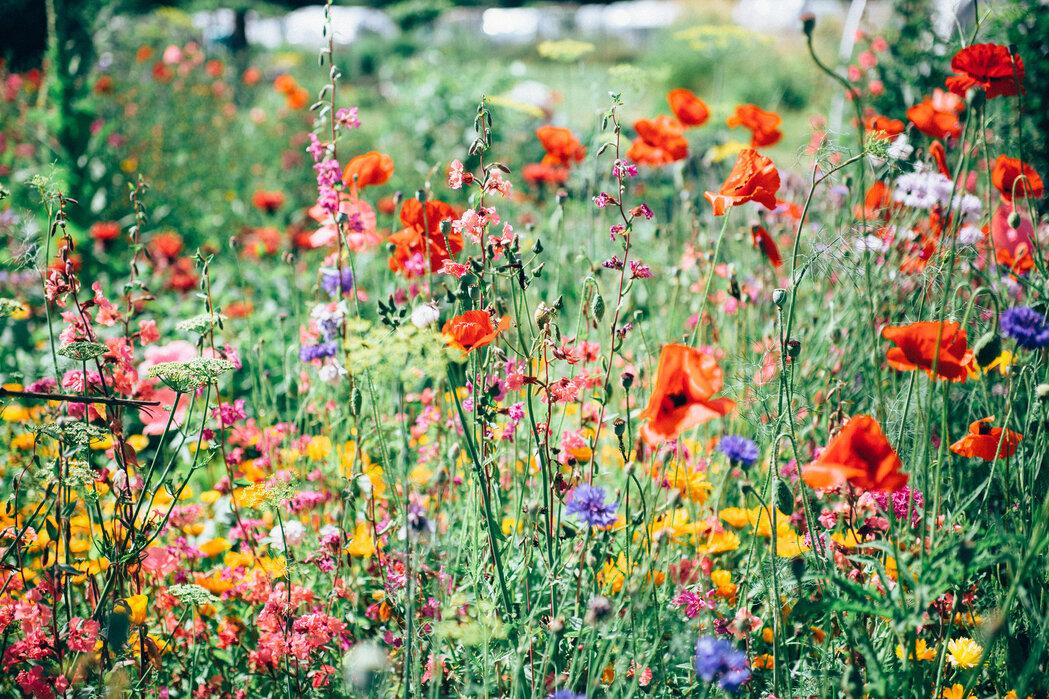
Our Parks Team takes great pride in creating a more biodiverse City. In recent years, natural grass areas have been established in one way by reducing mowing in parks and open spaces. This has allowed an increase in wildflowers and plants which attract insects, birds and mammals to create species-rich environments.
For more information and a list of sites with areas of naturalised grass or meadow, visit this dedicated page on Southend City Council's website.
Dimming Street Lights
Southend-on-Sea City Council has taken a sustainable approach to street lighting to reduce energy use and light pollution wherever it is safe to do so. Around 97% of Southend-on-Sea's 15,000 street lights are connected to a central management system, allowing them to be dimmed during the night. There was a full upgrade to energy‑efficient LED lighting in 2018. Dimming has been in place across most areas since, with lights only kept at full brightness at major junctions and pedestrian crossings to maintain safety. Not only does this reduce energy use, but it also promotes biodiversity and activity of nocturnal species, which are often at increased risk in urban areas.
Council's Carbon Emissions Cut Over Recent Years
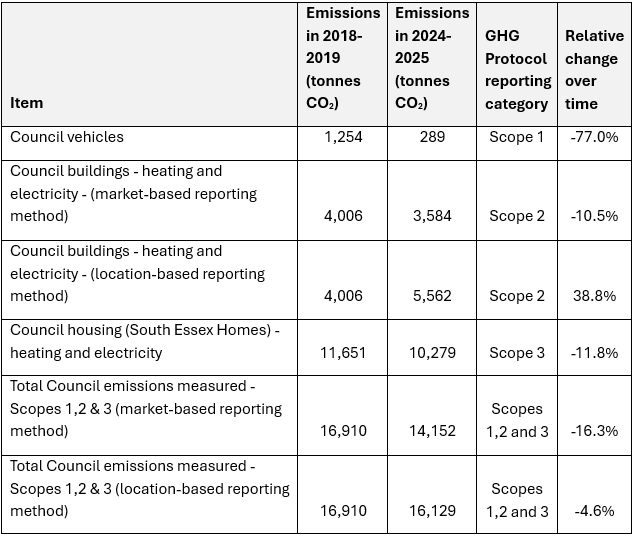
The carbon emissions produced annually by Southend-on-Sea City Council’s operations have fallen over the last six years. In fact, they have reduced by up to 16%. Council emissions were measured for two years, 2018-2019 and 2024-2025, using standard accounting methods. This was to understand better our progress towards our 2030 ‘net zero’ target, which was agreed by the Council when we declared a Climate Emergency in 2019.
The reduction seen in emissions reflects the impact of:
- energy efficiency improvements made to council-owned housing and corporate buildings, also known as 'retrofit' works.
- changes in the size of the Council’s estate and vehicle fleet
- the switch to a certified ‘zero carbon’ tariff for electricity used in non-residential Council buildings, as well as other small changes we have made to be more sustainable.
The impact of these changes is shown in the table below. Included in the table are two standard reporting methods used for reporting emissions data. The ‘market-based’ method includes the impact of the zero-carbon electricity tariff. While the ‘location-based’ method ignores that tariff and assumes that electricity used in buildings has the same carbon intensity as the national grid. The table shows that even if the zero-carbon tariff is not counted, the Council’s emissions still fell by 5% between 2018-19 and 2024-25. The table also shows that emissions from parts of the Council’s supply chain, which includes housing owned by the council, are greater than those from its vehicles and non-residential buildings. While estimation of all Council supply chain emissions has not yet been possible, it will be needed to support the pathway to net zero.
Carbon emissions of Southend-on-Sea City Council in 2018-19 and 2024-25: